
- Azel Law Firm
- Family Law
- 27 October 2025
The fate of property and jewellery acquired during marriage after divorce in 2025 of family law remains one of the hottest topics. In recent years, the approach of the Court of Cassation regarding wedding jewellery/ornaments has evolved markedly into a “case-by-case” standard; during the same period, through “new judicial packages” property regime its debates have gained momentum. In this article, we examine the framework of the current system, the criteria introduced by recent case law, and what potential reforms might change in practice, in a clear and institutional style tailored for the readers of Azel Law.
Current System: The Regime of Participation in Acquired Property and the Status of Jewellery
Since 01.01.2002, the legal regime has been the participation regime for acquired property. Put simply:
- Acquired propertyValues acquired in return for labor within marriage and legally considered as acquired property. In liquidation, the principle of distribution based on “residual value” applies.
- Personal effectsPre-nuptial assets, items excluded from division such as acquisitions through gift/inheritance.
- JewelleryIn the classical view, it was mostly considered personal property; however, which spouse it belongs to, or who it was presented to, is determined in light of customs and concrete evidence. With the new jurisprudence, the acceptance that it is “automatically considered the woman's property in every case” has been replaced by the concrete case test.
New Era at the Court of Cassation: Sequential Criteria System for Bridal Jewellery
Current case law adopts an approach focused on concrete events and evidence rather than rigid generalisations regarding wedding/engagement jewellery. The main principles are:
- Agreement between the parties takes priority. If there is a written or verbal agreement before/after the wedding, it shall be complied with.
- Proof of custom and usageIf there is no agreement, and local customs can be proven with evidence, affiliation shall be determined accordingly.
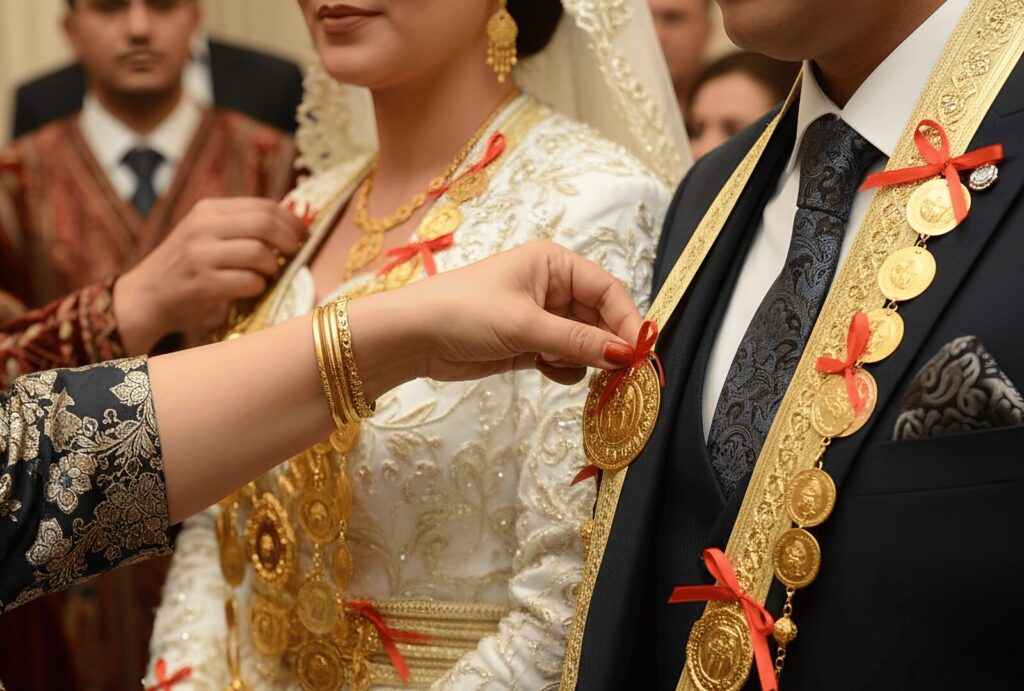
- “As a rule, whatever was pinned or given belongs to the person it was given to.” Thirdly, the significance of who concretely wears the piece of jewellery is decisive.
- Gender-specific itemAs a general rule, items of jewellery and accessories such as watches, prayer beads and sets that are characteristic of use by a specific gender are considered to belong to that gender. If the gender specificity is disputed, an expert witness is brought in.
- Jewellery pouch/boxValues thrown into the bag during the ceremony that could be considered specific to both sexes partner acceptable; sex-specific ones are written under the relevant sex.
This framework softens the years-long understanding that “everything pinned at the wedding belongs to the woman”, shifting towards a case-by-case determination of ownership. Consequently, the male spouse's claim for return or compensation regarding jewellery pinned on the man or specific to him has now become more strongly arguable. Likewise, items that can be considered unisex, such as “quarter sovereigns thrown into the bag”, can also be written down under the partnership column.
Practical Effects of Property Regime Liquidation
The new approach directly affects the claim structure and evidence strategy in divorce and property regime lawsuits:
- “The ”jewellery = always the woman's personal property" mould has been broken. Who it was gifted to, gender specificity, and the pouch/partnership distinction can now alter the liquidation schedule.
- In the calculations of participation receivables and value increase shares, under which heading the jewellery will be listed (as personal property or as a marital property item) will be determined according to concrete evidence.
- The return and the claim for the price must be structured together; current market rates should be taken into account for the price.
- The role of the expert witness has become prominent: technical opinions are critically important for an accurate outcome in debates over whether it is “gender-specific” or “unisex”.
Possible Reforms in 2025: What to Expect Regarding Jewellery and Property Regimes
The 2025 agenda is discussing topics such as simplifying the division processes in family law, making property regime agreements more accessible, and protecting family assets. Although there is no final and currently in-force concrete provision specifically regarding bridal jewellery (ziynet):
- There is a clear need for a normative framework that reduces ambiguities in practice.
- The coordination of divorce and liquidation proceedings (e.g., concluding them in the same case) is being discussed.
- The preservation/collection of evidence and more systematic evaluation of electronic records are on the agenda.
The entry into force of any of these headings could bring about a more predictable application, consistent with the case law along the “who was caught–sex specificity–omnibus/partnership” axis.
Most Common Scenarios and Roadmap
1) The “quarters thrown into the dustbin” file
- Bag practice is identified through photos/videos, instant recordings and witness accounts.
- Considering the possibility that the unisex gold items may be registered in the partnership column, alternative claims (participation receivable + restitution in kind/value) are structured together.
2) “Men's jewellery set/watch” file
- Whether the jewellery's characteristics (whether it is specifically for men's use) are clarified by an expert witness.
- If a refund is not possible, the price is claimed separately in the price calculation as the current market rate and the share of value increase.
3) The allegation of “what the woman spent/exchanged”
- The burden of proof varies according to the specific case; if there is a claim of cashing-in, digital and written evidence such as jeweler records, bank receipts, and text messages are collected.
- “The question ”Where did the spending go?" affects the refund/cost balance.
4) “Jewellery acquired before marriage / inherited” file
- Acquisition before marriage or by way of inheritance retains its character as personal property as a rule; mixing/substitution arguments determine the evidentiary plan.
- “A timeline and financial records are prepared for the audit trail of the value superseding the previous value.
Evidence and Procedure: Steps to be Taken (Checklist)
- Audio-visual evidenceThe videos and photos of the wedding moment, the jewellery who they are hanging out withsquares that show the net clearly.
- WitnessesEyewitnesses, close and reliable sources to the gift-giving ceremony at the wedding.
- DocumentJeweller's receipt/invoice, bank transfer/EFT advice note, WhatsApp/e-mail correspondence.
- Expert witnessTechnical perspective on gender specificity and unisex debates.
- Demand architectureSimilarly, if restitution in kind is not possible, the value, at the current market rate; furthermore, the participation receivable and the value increase share should be established together in the alternative.
Property Regimes and Jewellery in Turkish Family Law
Frequently Asked Questions (FAQ)
In this section, we have gathered the most frequently asked questions about property regimes and jewellery with short and clear answers. You can find the rules on the sharing and proof of gold given at weddings, as well as the key points regarding potential changes in 2025.
Should I file the jewellery lawsuit together with the divorce case?
It depends on the specific case. Evidence can be handled together if it is presented more efficiently in the same file, or separately if required by procedural economy. The aim is to strike a balance between speed, cost and accurate decision-making.
“Is the era of ”whatever is given to the man also belongs to the woman" completely over?
No. If there is an agreement and custom, they are applied. Otherwise, the principle of “to whom it was pinned, it is theirs” comes into play; gender-specific and bag/partnership exceptions are determined according to the event.
Can I claim the quarters thrown into the fountain by myself?
Values accepted as mutually agreed can be counted as a partnership item. In this case, the claim is established around the share in the partnership and/or participation receivable; strong evidence is required.
Are inherited golds shared?
Jewellery acquired by inheritance is, as a rule, personal property. However, in claims involving commingling or substitution, the burden of proof and the timeline are of critical importance.
Can a property regime agreement be made afterwards?
Yes. It can be drawn up before a notary public; it should be remembered that subsequent contracts will not have retroactive effect.
Result: A New Era in Asset Division
We have entered a period in the fields of jewellery and property regimes that focuses on the specific case rather than general acceptances. The sequential test of “agreement – custom/tradition – who it was pinned on – gender-specific – bag/partnership” directly affects both jewellery claim lawsuits and the liquidation of property regimes. Regulations that may come to the agenda in 2025 could make practice more predictable; however, in today's world, success is possible with the right evidence architecture and alternative claim structuring.
As Azel Law, we evaluate current jurisprudence and potential reform scenarios together in ornament (jewellery) claims, property regime agreements, participation/value increase shares and liquidation strategies; and we stand by you for the fastest and most effective solution best suited to your specific case.